


"At a time of rapid technological advancement and evolving regulatory expectations, investments like this demonstrate how our industry continues to move forward responsibly. "
Director's Log 
OCIMF members, industry colleagues and friends gathered in Leer, Germany, to mark the launch of Thun Resolve – a proud milestone for Thun Tankers and MF Shipping Group, and a testament to the craftsmanship of Ferus Smit who built her.
It was a pleasure to witness this important moment as the vessel entered the water. A ship launch reflects the collective effort of owners, designers, builders, and operators working together to deliver a vessel fit for the future. My sincere thanks to Karin Orsel, CEO MF Shipping Group, and all involved for the warm welcome and the opportunity to share in such a significant occasion. A video of the launch, which took place on 12 February, is available here.
Thun Resolve stands as a symbol of innovation: modern, efficient design combined with a clear commitment to safety and environmental performance. Importantly, the vessel has been designed with strong emphasis on the wellbeing and health of the crew, helping to improve living standards and support the day-to-day experience of the seafarers on board. At a time of rapid technological advancement and evolving regulatory expectations, investments like this demonstrate how our industry continues to move forward responsibly.
For OCIMF, this aligns directly with our mission. Ultimately, innovation should strengthen safe operations and support the people who operate these ships every day.

Karen Davis
Director OCIMF
Do you have news that you'd like to share with our readers? If so email
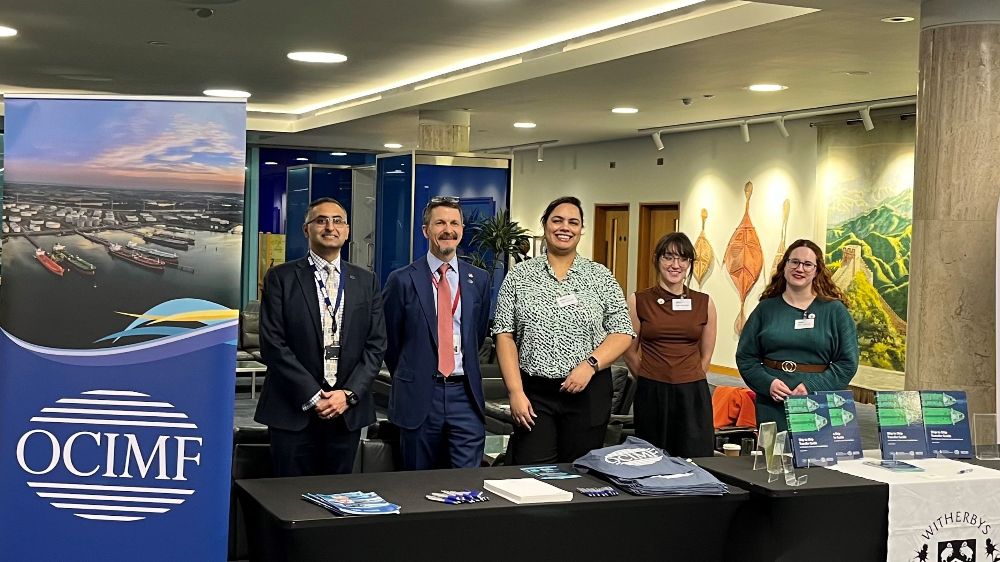
OCIMF connects over coffee at IMO
OCIMF hosted a coffee session at the IMO to promote the Ship to Ship Transfer Guide, supported by its publisher Witherbys and co-authors ICS, SIGTTO and CDI.
The session, which took place on 9 February during the Sub-committee on Pollution Prevention and Response, provided an opportunity for the wider OCIMF Secretariat to connect with IMO delegations, supporting open dialogue with those shaping maritime policy and recognised best practice. The event was well attended, with around 400 participants, and saw strong engagement from delegates throughout the day.
Publications news
Guidelines for large ships transiting the Danish Straits through the Great Belt.
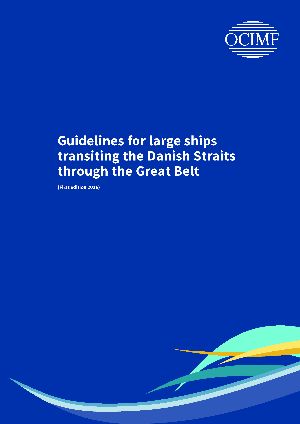 There has been an increased flow of large ships carrying hydrocarbon cargoes transiting the deep-water route of the Danish Straits (Route T) since 2022. Mariners passing through the Danish Straits via the Great Belt – the western, deeper strait – face challenging navigational conditions, including water depth, currents, climatic conditions and traffic density. These conditions can be minimised through good organisational and navigational planning.
This new information paper provides operational and organisational guidance for ship operators in developing risk assessments for large ships transiting from Skagen to Bornholm (southbound) or Bornholm to Skagen (northbound) through Route T.
Information paper updates
Volatile Organic Compound Emissions from Cargo Systems on Oil Tankers (2019)
This information paper presents the technologies and methods that are currently available for controlling or treating Volatile Organic Compound (VOC) emissions from oil tanker loading and during vessel transit.
It has been updated in February 2026 to reflect current regulations (section 2), current practice (section 6), performance (section 9), and training (section 12).
Go to https://www.ocimf.org/publications/information-papers for all information papers, which are free to download.
Work begins on Falls to Water project
The OCIMF project on Falls to Water (FTW) convened its first working group meeting on 12 February with strong engagement from internal members and active participation from external stakeholders.
A primary output of this work will be the development of a guide covering a broad spectrum of marine operations including vessel operations, terminals, offshore vessel operations and inland waterways. It will provide consolidated, practical guidance to address gaps within the currently fragmented industry publications and support organisations in enhancing their risk assessment processes and implementing risk controls aligned with their specific operational context.
Organisations supporting the work include INTERTANKO, InterManager, The Nautical Institute, International Marine Contractors Association, International Harbour Masters’ Association, Baltic and International Maritime Council, Platform Zero Incidents and the American Waterways Operators.
The initiative is driven by the increasing number of FTW incidents across the maritime sector, with more than 130 fatalities recorded since 2020 and numerous serious non-fatal cases. Such incidents occur during activities including personnel transfers, ship-to-ship operations, mooring operations, and the rigging of access equipment. This upward trend highlights an urgent need for coordinated industry action to deepen understanding of associated risks and strengthen mitigation measures. While guidance on this topic exists, it is dispersed across multiple sources, reinforcing the need for consolidation, gap analysis, and improvements informed by lessons learned.
For more information, contact Javed Bhombal, OCIMF Nautical Adviser,
OCIMF staff announcement
Captain Sashidaran Gopala has moved from his previous position of SIRE Technical Adviser into the role of Programmes Technical Manager.
Sashi is exceptionally qualified to take on this responsibility and will continue the great work that has been done so far in this post. We would like to acknowledge Sashi’s outstanding efforts in member engagement, his undeniable knowledge of the subject matter, and his tenacity to see things through. He has consistently gone the extra mile to deliver services, and we’re confident he will bring the same dedication to this new role. 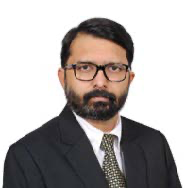
Sashi will continue to work remotely in the role, enabling him to incorporate advocacy and project work while contributing to member and Secretariat collaboration.
Environment Committee
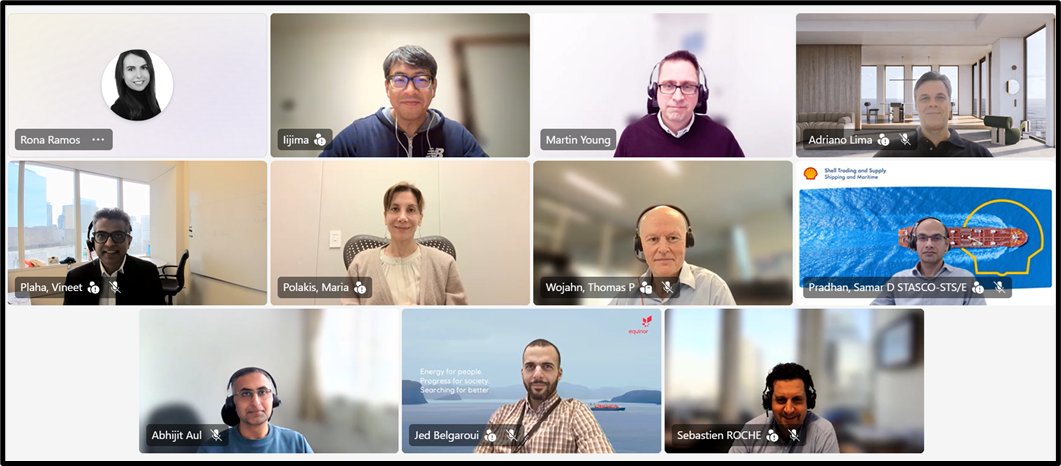
Intersessional meeting 11B: 17 February (virtual)
Chair: Maria Polakis (BP)
Secretary: Martin Young (OCIMF Environmental Adviser)
The Environment Committee intersessional meeting heard an update on the latest energy scenarios that highlighted differing perspectives about future marine fuel options. The meeting also considered requests for co-sponsoring papers to the 21st meeting of the IMO’s intersessional working group on greenhouse gases and discussed preparations for the next in-person committee meeting to be held on 17–18 March at OCIMF’s London office.
For more information, contact Martin Young, OCIMF Environmental Adviser,
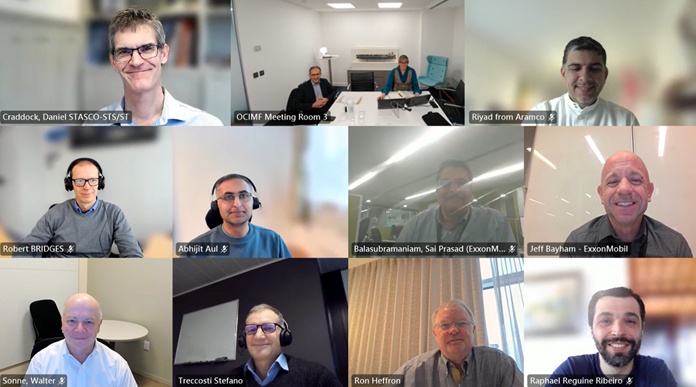
Structures Expert Group
17th meeting: 19 February 2026 (virtual)
Lead: Jeff Bayham (ExxonMobil)
Co-lead: Gerard Spaan (Shell)
Secretary: Lexy Nielsen (OCIMF Engineering Adviser)
The Structures Expert Group (SEG) held its first meeting of the year, focused on planning for publication work in 2026. Recent reviews of three information papers were discussed with a comprehensive plan to incorporate them into the upcoming revisions of OCIMF flagship publications. The multi-buoy mooring guidance revision drafting is progressing smoothly and the SEG will lead the pending revision of the Mooring Equipment Guidance, due to begin later this year.
The SEG continues to support a collaborative and harmonised maritime industry through working group participation with British Standards and PIANC. The group discussed the recent PIANC MarCom meeting, including updates on the SEG-supported working groups and suggesting topics for new PIANC workstreams.
Fair winds and following seas to Rabinder Manku, who will be leaving the SEG after 10 years. The SEG thanks Rabinder for his dedication and contributions to OCIMF.
For enquiries, contact Lexy Nielsen, OCIMF Engineering Adviser,
IMO news
13th Sub-committee on Pollution Prevention and Response (PPR 13)
PPR 13 took place from 9 to 13 February 2026 at the IMO headquarters in London. The meeting was held in hybrid mode with the following developments of relevance to OCIMF membership.
MARPOL Annex II – chemical tanker matters
- Carriage of pyrolysis oils generated from waste products: sub-committee noted expressions of interest in developing carriage requirements.
- Prewash procedures for high melting point/high viscosity products and Fatty Acid Methyl Esters (FAME) cargoes: discussions on enhanced prewash procedures for these cargoes to continue during the Evaluation of Safety and Pollution Hazards of Chemicals (ESPH) expert group later this year.
The aquatic environment
- Management of wash water from Exhaust Gas Cleaning Systems (EGCS): discussions on environmental impact of discharge water proves inconclusive. Expressions of interest in determining efficiency of EGCS in reducing particulate matter.
- Biofouling: intersessional group to develop a draft structure for a statutory regulatory framework and the work plan going forward.
Matters relating to air pollution
- Black Carbon emissions and concept of 'polar fuels': sufficient interest in the concept, however further scientific evidence sought on the benefits of introducing new requirements.
- NOx emissions: discussions on introducing new requirements for testing and assigning weightage to low load operations.
- Volatile Organic Compounds: agreement of amendments to cargo tank P/V valve opening pressure for new crude oil tankers.
Other matters
- Carriage of plastic pellets: discussions on proposed mandatory instrument to regulate carriage.
- Amendments to MARPOL Annex I: recording of machinery space operations for integrated bilge treatment systems.
For enquiries regarding IMO matters and meeting participation, contact Abhijit Aul, Risk and Regulatory Affairs Adviser,